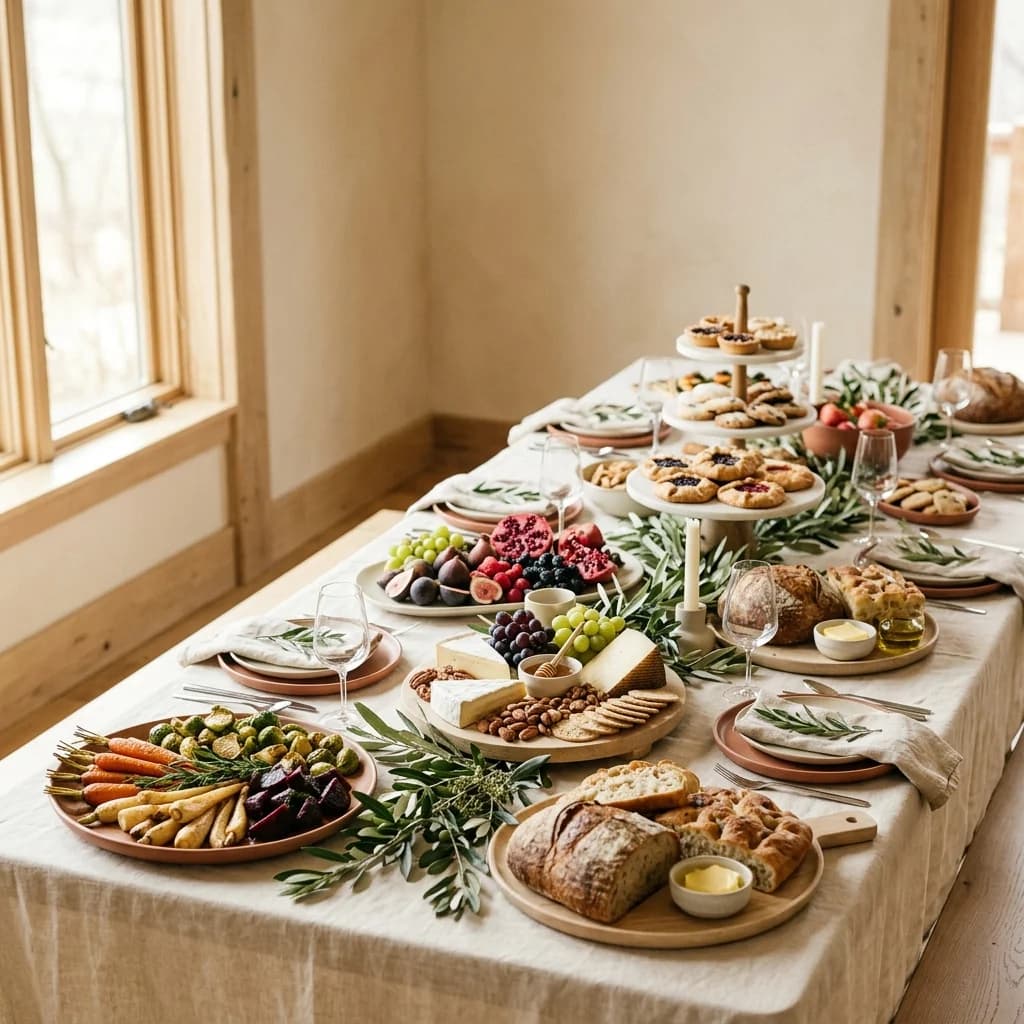
Almost every quantity mistake comes from planning per person and stopping there. The right number depends on three variables together: how long the event runs, what time of day it starts, and whether guests will eat a meal before or after it. Fix those three and the arithmetic is easy.
Start with the role the food is playing. As an appetiser before a meal, plan four to six pieces per guest for the first hour and two to three for each hour after. As the meal itself, plan ten to fourteen pieces per guest for a two-hour event, and weight at least half of that towards substantial items — tartlets, sandwiches, arancini, skewers, something hot if the space allows it.
By weight, a grazing table works out at 150 to 200 g of food per guest when grazing comes before a meal, and 300 to 400 g when it replaces one. That is the single most useful conversion in party planning: 30 guests at a table that is the meal means roughly 10 kg of food across the six categories, and the shopping list follows from there. Cheese sits around 60 to 90 g per person as part of a wider table, dropping towards the bottom of that band when hot savoury items are also on the surface.
Time of day shifts the whole plan. An event starting at 2 p.m. lands between meals and needs less. One starting at 6 p.m. is dinner whether or not the invitation said so, and guests will arrive planning to eat properly. A 7.30 p.m. start after most people have eaten behaves like an appetiser event again. Ottawa adds a winter version of this: guests who have driven across the city in the cold and shed coats and boots at the door eat noticeably harder in the first twenty minutes than the same guests in July.
Event length adds a second-order effect. People eat most in the first half hour and then again after any speech or programme. A three-hour party lands around twenty per cent above a two-hour party, and it wants that extra food held back for a second wave. Laying everything out at the start means the surface looks picked over exactly when the room is fullest.
Variety and quantity are separate levers, and confusing them is expensive. Twelve items at half quantity looks thin within twenty minutes; six items done generously reads as plenty for three hours. Under twenty guests, fewer categories done well wins every time. The reliable place to spend the extra money is the substantial category and the crackers, which are the two things that run out first.
Turning the weight into a shopping list is the step where plans fall apart, so do it as a division. Take the total — say 10 kg for thirty guests at a table that is the meal — and split it roughly a third rich, a fifth fresh, a fifth substantial, and the remainder across salty, crunchy and sweet. That gives about 3 kg of cheese and cured meat, 2 kg of fruit and vegetables, 2 kg of substantial savoury, and the rest in olives, crackers, nuts and small sweets. Buy to those four numbers and the table balances itself.
Reserve about a third of the menu for guests who eat vegetarian, and label everything. Labels do two jobs at once: they let guests with restrictions serve themselves without a conversation, and they slow down the people who would otherwise take one of everything. Allergies need a step further than a label, and the honest position is worth stating before anyone books: dietary preferences and allergy information get planned for and labelled, and a shared table cannot be guaranteed allergen-free.
December is where all three variables collide. A house party on a December Saturday often sits between an office lunch and a family dinner, so the same thirty guests eat like an appetiser crowd. The following weekend, the same room at the same hour is the only meal anyone has planned. Ask two or three guests what else is in their day that week; it is a better predictor of appetite than any per-person figure.
Plan the leftovers on purpose. A table designed to look full at the ninety-minute mark will have food left, which is the correct outcome. Decide in advance who boxes it and where it goes, so the end of the night is a two-minute job. On our own events the leftovers are boxed and left with the host, and the boards, risers and linens leave with us.
Two quantities that people forget until the day: ice, and something to drink for the guests who are driving. Both sit outside catering, and both decide whether the food gets eaten at the pace you planned for.
| Event shape | Pieces per guest | Weight per guest | Substantial pieces |
|---|---|---|---|
| Snacks with drinks, one hour, dinner to follow | 4–6 | 150–200 g | 2–3 |
| Two-hour party, guests eat elsewhere afterwards | 8–10 | 200–250 g | 3–4 |
| Two-hour party, the table is the meal | 10–14 | 300–400 g | 5–7 |
| Three-hour standing event, the table is the evening | 14–16 | 400–450 g | About a third of the table |
| Guests | Total food | Cheese | Crackers and crostini | Substantial pieces |
|---|---|---|---|---|
| 12 | 3.6–4.8 kg | 0.9–1.1 kg | about 85 | 60–85 |
| 20 | 6–8 kg | 1.5–1.8 kg | about 140 | 100–140 |
| 30 | 9–12 kg | 2.2–2.7 kg | about 210 | 150–210 |
| 50 | 15–20 kg | 3.5–4.5 kg | about 350 | 250–350 |
How much food do I need for 30 guests?
For a table that replaces dinner, plan roughly 9 to 12 kg of food in total — about 350 g a head — spread across six categories, with 150 to 210 substantial pieces inside that. If guests eat a meal before or after, halve the weight and cut the substantial pieces to two or three each.
How much food per person for a two-hour party?
Ten to fourteen pieces per guest when the food is the meal, and eight to ten when a meal happens elsewhere. Hold about a third of it back for the second wave after any speech, because the first thirty minutes take the biggest bite out of the surface.
How much cheese should I buy for a party?
Around 60 to 90 g per person when the table also carries cured meat and substantial savoury items, rising towards 120 g when cheese is doing most of the work. Three to five cheeses across textures reads as more generous than five of the same style.
How Much Food for a Party — the short version
- Appetiser role: 4–6 pieces per guest in hour one, 2–3 per hour after.
- Meal role: 10–14 pieces per guest over two hours, half of them substantial.
- By weight: 150–200 g per guest as an appetiser, 300–400 g as the meal.
- 30 guests, table as the meal: roughly 10 kg of food across six categories.
- Cheese: 60–90 g per person within a wider table.
- A 6 p.m. start is dinner regardless of what the invitation called it.
- Three hours needs about 20% more food than two, released as a second wave.
- Six items done generously beats twelve done thinly, especially under 20 guests.
Planning this kind of event in Ottawa? Read how OH! handles party catering in ottawa, or browse the service areas we cover.
Planning something in Ottawa?
Tell us the date, guest count and the feeling you want. We’ll help shape the table around it.
Start an inquiry